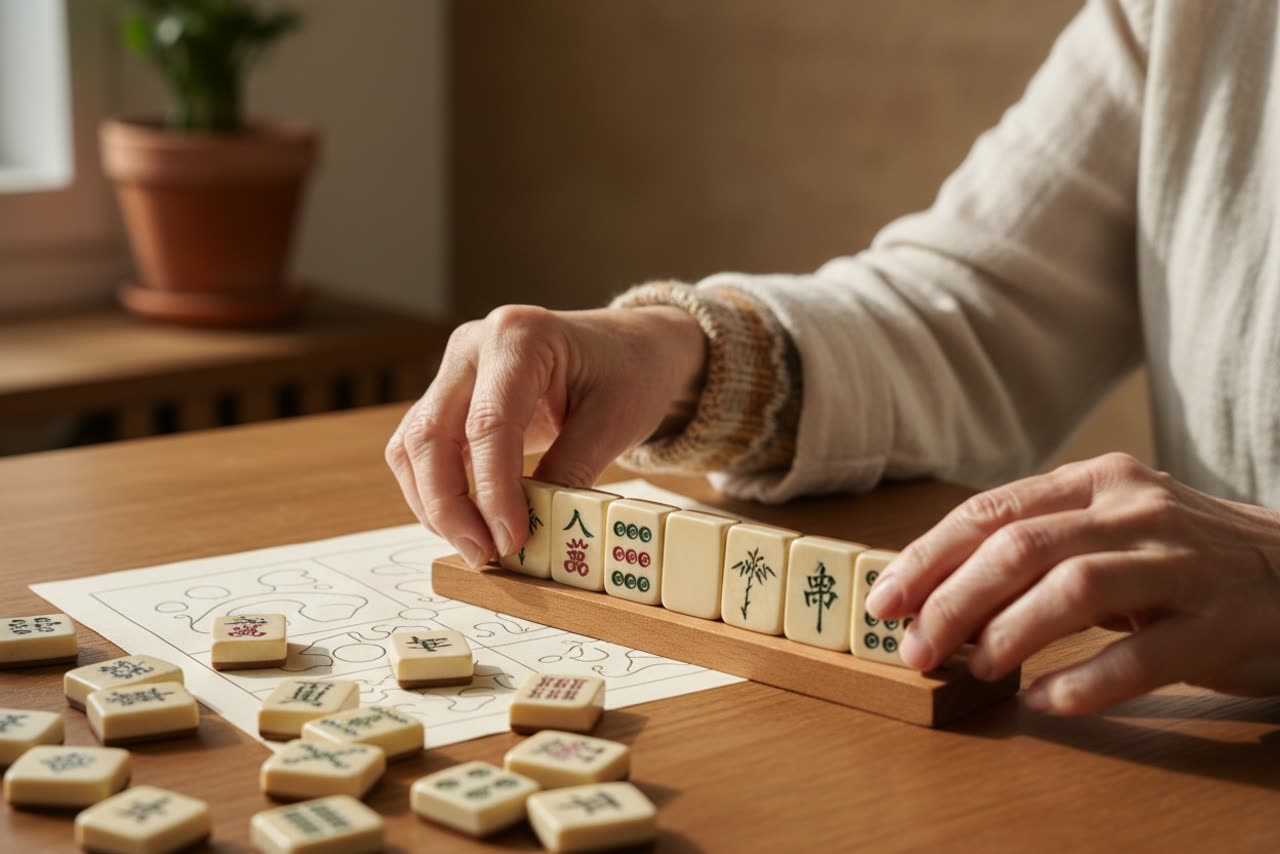
I kept thinking I was just too slow to get it. Then I realized nobody had ever explained what the card was actually telling me.
Nobody is bad at mah jongg. They're just reading a card nobody taught them to read.
Fast enough that nobody has to wait on you. Without a class, without a teacher, and without one more hour of YouTube filmed sideways at somebody's kitchen table. It starts with the card — the part everybody else skips.
If you have ever sat down and thought any of this —
— then nothing here is going to be news to you. And you are nowhere near alone in it.
“I almost cried during my first lesson. When I opened the card and Annie started explaining everything… the tiles, the card, the flow of the game… I had this sinking feeling like, this is too much, I should just walk out now and cut my losses. The only reason I stayed was because I didn't want to mess up the table numbers — and I didn't want to be embarrassed.”Carly Riordan, writing publicly about her first mah jongg lesson · carlyriordan.com
None of that is a memory problem, and none of it is an age problem. The card is a dense reference sheet written for people who already play. It was never designed to teach you anything.
And notice what the fear is actually about. It isn't losing — nobody minds losing. It's being the one the table is waiting on, and quietly not being asked back. That part nobody says out loud, which is exactly why it decides whether you ever sit down at all.
Which is why the fix isn't more practice. It's a key.
Everyone teaches you the moves. Nobody teaches you the card — and the card is the part that decides whether you can play at all. That's where this starts, and it's why seven days is enough.
Sounds too easy? Let me guess what you're thinking:
“People spend years on this. There's no chance I'm reading that card in a week.”
“I've watched the videos. Wasted evenings. I still couldn't tell you what FF DDD 111 2222 is asking for.”
I know. That is exactly the position this was written for — and it's why it starts at the tiles and not at the hands.
It's a reference sheet, printed for people who already play, by people who already play. It assumes you know the notation before you pick it up. Nobody could read it cold — and nobody handed you the key.
You were told mah jongg is a memory game. That you have to learn the hands. It isn't a memory problem. It's a reading problem — and those are solved completely differently.
Not your age. Not your memory. Memorisation — a teaching method that asks you to hold seventy hands in your head, and then throws them away every April when the League prints a new card.
That is a property of the card, not a fact about you. Stop memorising and start reading, and the whole thing changes shape.
This is a line written the way the card writes it. Look at it for five seconds and notice how little it tells you.
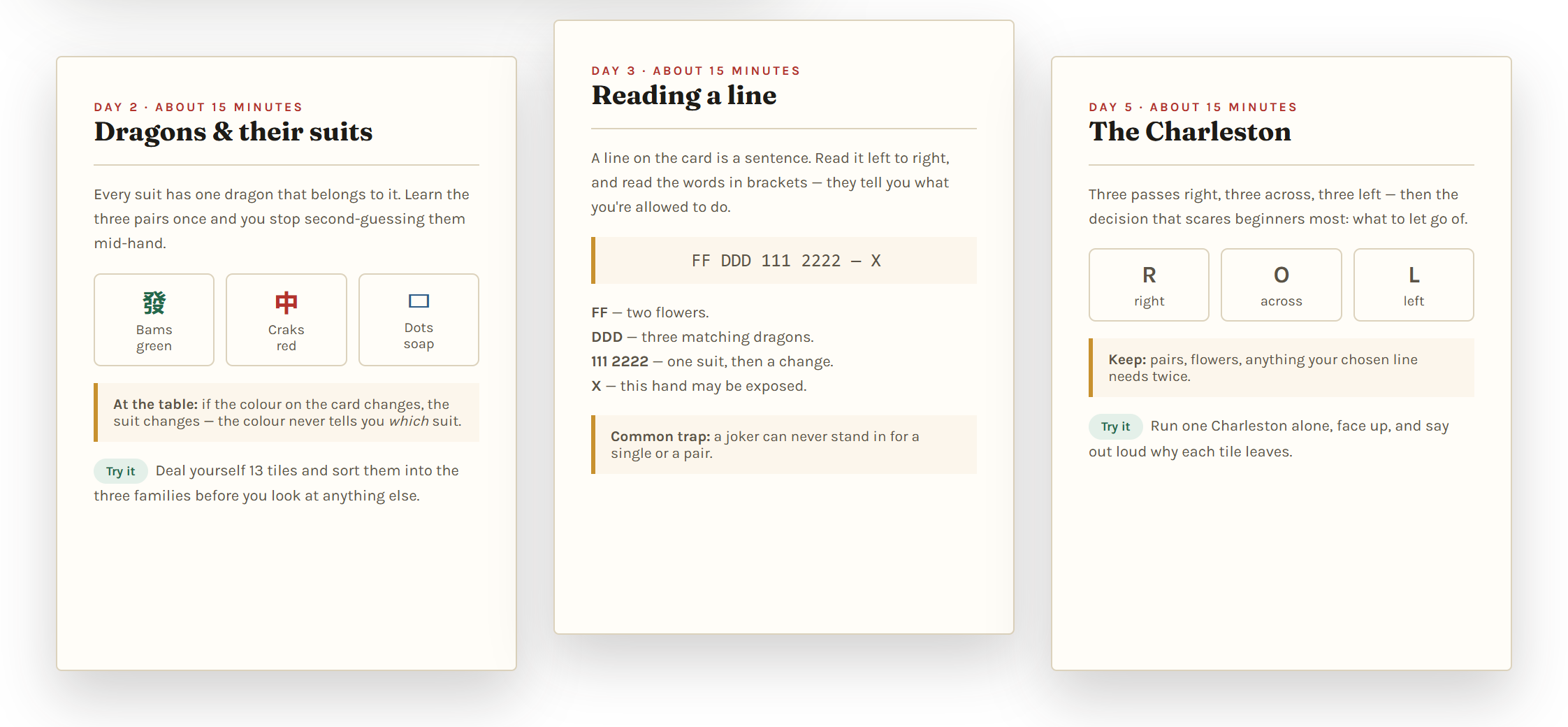
FF DDD 111 2222 — X
One more thing the card never tells you: a joker can stand in for a tile inside the DDD, the 111 and the 2222 — but never inside the FF. Jokers work in groups of three or more. Never in a pair, never in a single.
And that's the whole trick —
You just read a mah jongg hand.
A minute ago that line was a row of symbols.
That's one line. There are dozens on the card, and they are all built from the same handful of rules.
That is the entire secret. The card isn't difficult. It's compressed — a notation written in shorthand, for people who already play. Learn the notation — roughly nine rules in total — and every line on every card, this year and next, becomes readable.
The guide below walks you through all nine, one at a time, with a worked example for each.
Show Me the Other Eight Rules60-day money-back guarantee. Keep the bonuses either way.
FF DDD 111 2222 — X
…completely meaningless
Same line. Same card. Seven days apart.
Open any mah jongg book, any cheat sheet, any video. They all do the same thing: they walk you through this year's hands, one at a time, and ask you to remember them.
and round it goes
It's an enormous amount to hold in your head. And it has an expiry date — the League publishes a new card every spring, and the list you memorised is gone.
But the card was never a list. It's a compressed notation — a shorthand with a fixed grammar. The hands change every April. The grammar hasn't changed in decades.
Nine rules. That's the entire language the card is written in — every letter, every number, every colour. Learn the nine and you're not memorising hands any more. You're reading.
You already saw one of the nine, up above. Here are all nine.
Every letter, number and colour the card uses is governed by one of these. You just used the third one.
So 2222 is four number-twos — not two thousand, and not "a count of two".
Flower, dragon, the four winds — and 0, which is soap, the white dragon standing in as a zero.
Same colour, same suit. A different colour must be a different suit. Which suit is always your choice.
Single, pair, pung, kong, quint, sextet — and every tile inside a group is identical.
Never in a single. Never in a pair. This is the first mistake almost every beginner makes.
And the default catches people out: if the bracket doesn't say the numbers may change, the printed numbers are the only ones allowed.
Red to craks, green to bams, soap to dots. Unless soap is being used as 0, or the line says any dragons.
With the exception nobody tells you: in a C hand you may still call the fourteenth tile to win on it.
Concealed hands pay more. That is the whole reason to choose one line over another.
That's the language. The guide takes them one at a time, in order, with a worked hand beside each — and every rule on this page is checked by a certified NMJL instructor before it ships.
We can't reproduce the card — it belongs to the League. Which means every single example line in this guide had to be written from scratch, in the card's own notation, and checked to make sure it was legal.
That's the part that took the time. Not the writing — the reduction. Working out which rules were actually load-bearing, and which were just things people repeat. Nine survived. Everything else turned out to be a consequence of one of the nine.
Before it goes out, every rule and every worked hand is checked by a certified NMJL instructor. We'd rather be slow than be the reason somebody makes an illegal hand at a real table.
The hands are reprinted every spring. The notation hasn't changed in decades. Learn the one that lasts.
Small enough to actually hold in your head while three people wait for you to play.
Including the one that lands next April, before anyone has written a guide for it.
The single place beginners go wrong — and the one most guides skip entirely. It's rule three, not an appendix.
The guide stays open beside your rack at the speed you need it. The short clips are there for the few things that are easier shown than written — two or three minutes each, not a lecture.
Readable at a dining table, in normal light, without reaching for your glasses.
Fourteen of them. You see the rule used before anyone asks you to use it.
It's a PDF. Print it once and the file has done its job — no account, no expiry.
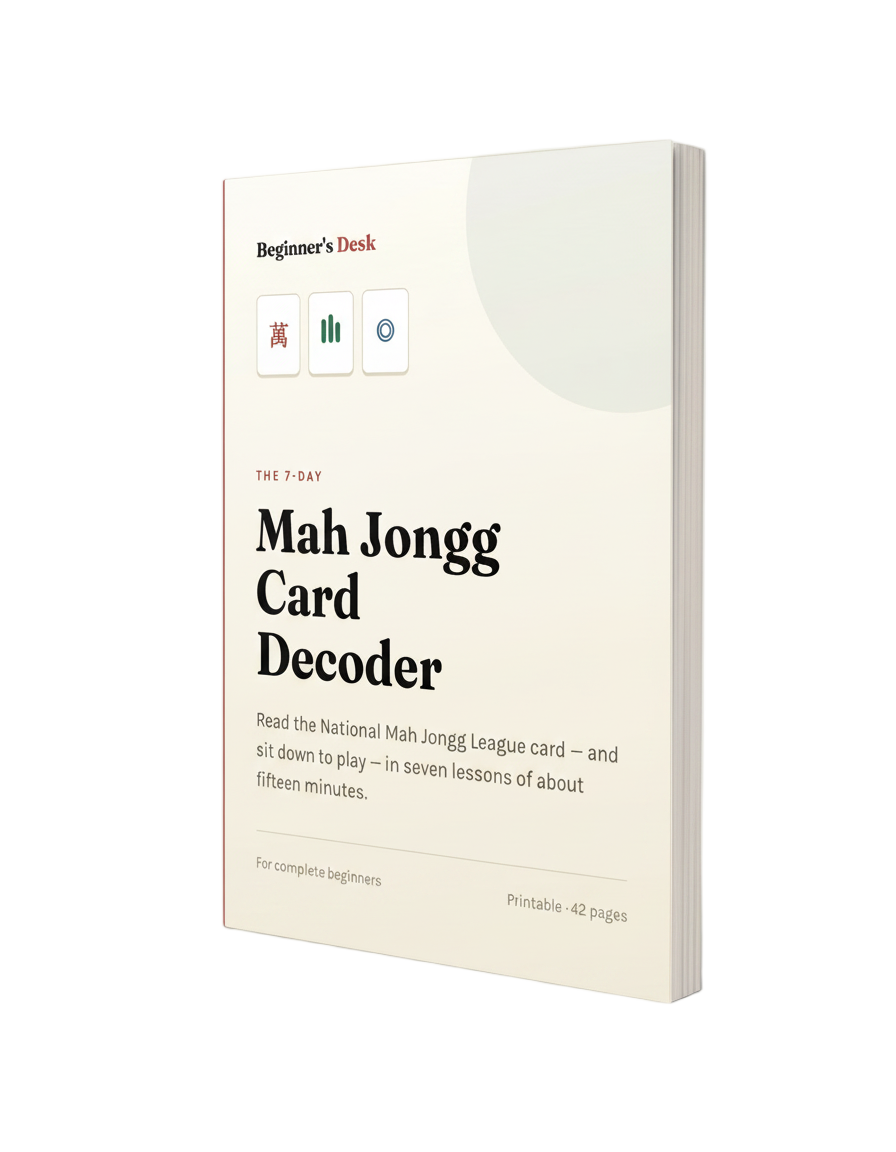
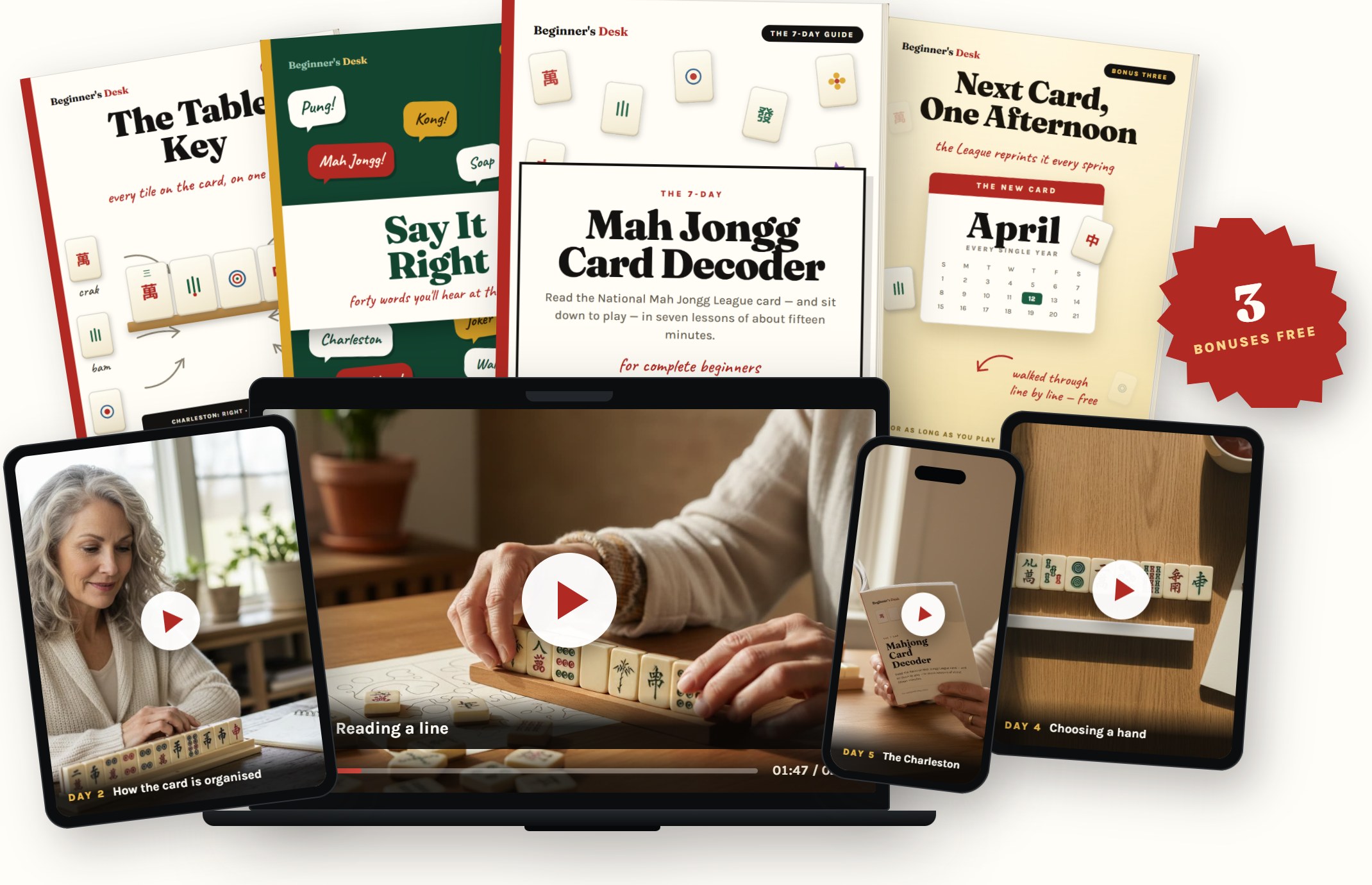
A 42-page printable guide — plus a short walk-through video for each day — that takes you from never having played to sitting down at a real table, in seven lessons of about fifteen minutes.
It doesn't reproduce the card. It teaches you the notation the card is written in, so you can pick up this year's card, or the one that lands next April, and simply read it.
Each day is a few printed pages and a short walk-through you can watch if you'd rather be shown. Do one a night, or the whole thing on a Sunday.
By the seventh one you're not reading the card at the table. You've already decided. Nobody is waiting on you, and nobody has any reason to think this is your first month.
YES — I Want to Keep Up at the Table
Not the card. The table — and the three people already sitting at it, waiting to see whether you can keep up.
We'd rather you buy well than buy from us. If you're looking at another book, a course or a laminated sheet, put it against these four:
| Free videos | A class or tutor | This guide | |
|---|---|---|---|
| Teaches the notation itself | Sometimes | Usually | Yes — it's the whole book |
| Still useful next April | Depends | You'd re-book | Yes |
| Goes at your pace | No | No | Yes |
| Available at 11pm | Yes | No | Yes |
| Sits on the table beside you | No | No | Yes — printable |
| Someone answers your question | No | Yes | By email, yes |
An in-person teacher beats a book on one thing — they answer you in the moment. If you have one, take them. This is for everyone who doesn't.
And one more admission. This guide does not contain the card. We're not permitted to reproduce it and we wouldn't want to — it's the League's, and you should buy it from them. What this teaches you is how to read it. Bring your own card; you'll be able to read it by the end.
Each one exists because of a specific moment where beginners get stuck.

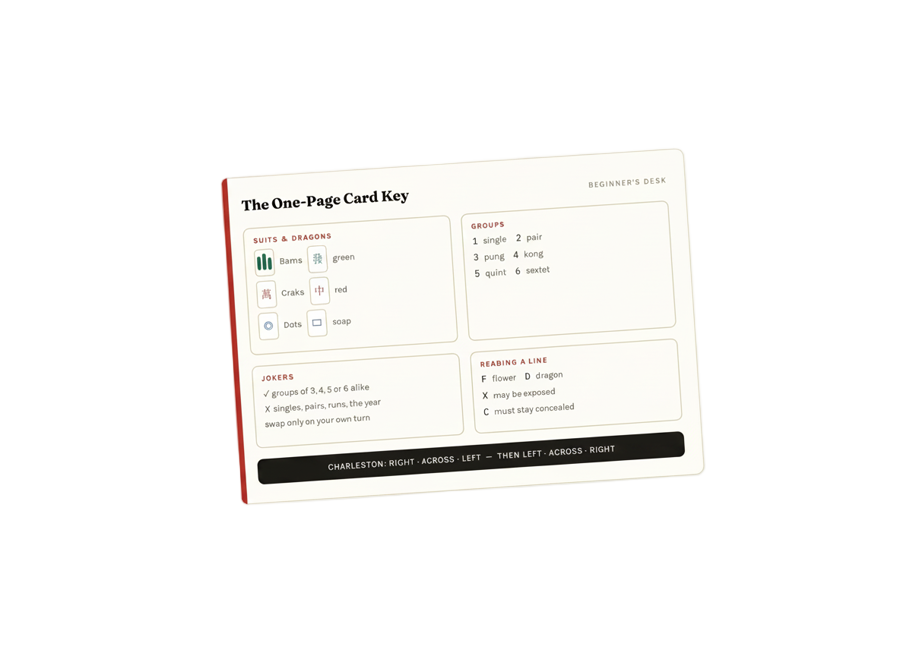
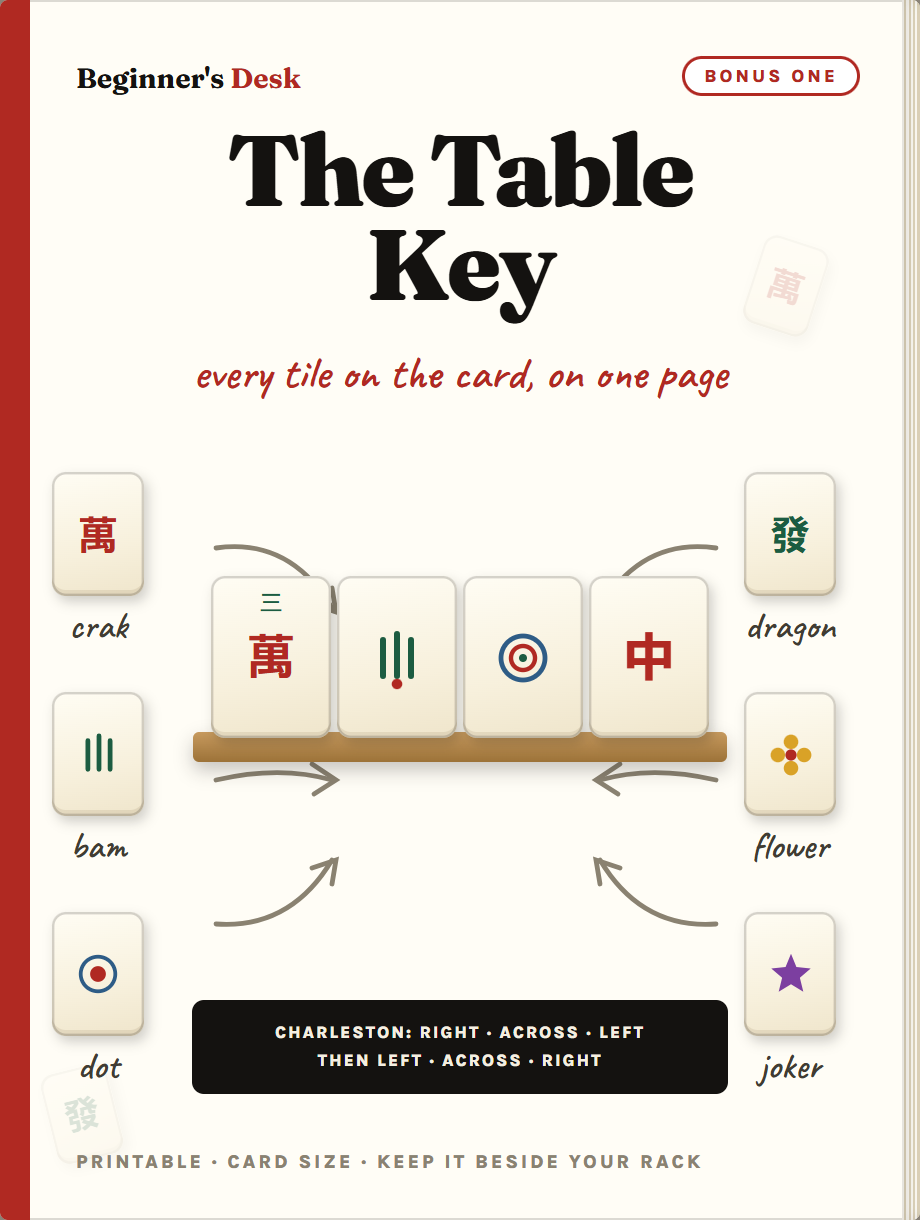
Why it exists: in your first few games you won't remember all nine rules, and flipping through 42 pages at a live table is not an option.
So you can keep one card-sized sheet beside your rack, glance down, and carry on — without anyone waiting.

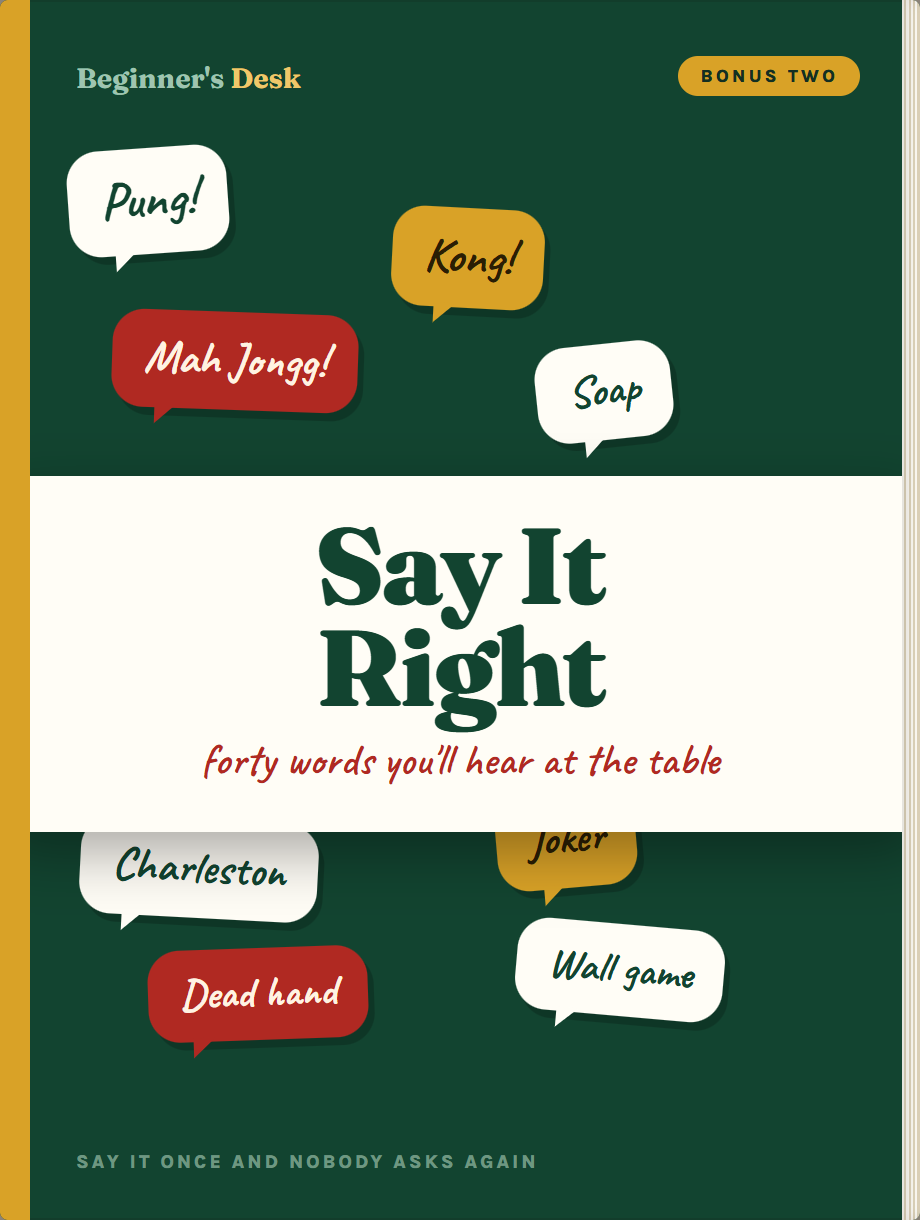
Why it exists: half of feeling like a beginner is not knowing the words. Pung, kong, soap, wall game, dead hand — they get said fast and nobody stops to explain.
So you can follow the table talk from your first game, instead of nodding along and looking it up afterwards.

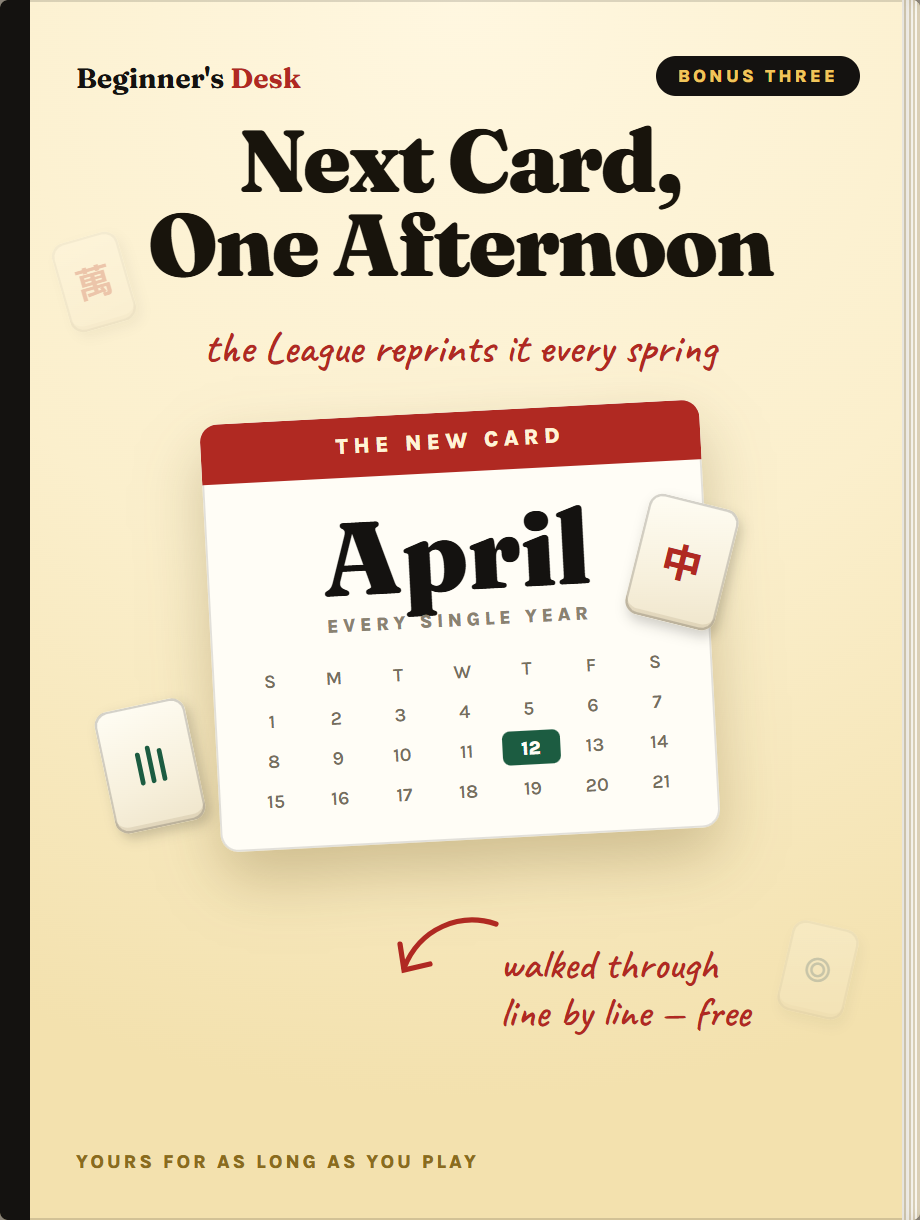
Why it exists: the League publishes a new card every spring, and that's exactly when a lot of beginners feel lost all over again.
So you can open the new card knowing it's the same nine rules — we email you the walkthrough when it lands, free.
New to the game, tired of rewinding, or wondering whether you would use a PDF?
If all this did was let you sit down at that table in April — and keep up — would that be worth $27 to you?
A beginner course at a JCC or a library runs $80–$310. A private hour with a teacher is $50–$100, and most people need several. The League's card alone is $14.
$27
Less than you already spent on the set. And the founding price holds at $27 while we test our first ads — the guide is new, and a low price is how a new guide gets found.
Instant access · one payment, nothing to cancel
Secure checkout by Digistore24 · one payment, nothing to cancel
Print it, work through it, take it to a game, and take as long as you like about it. If at any point in the next 60 days you decide it didn't do what this page said it would — write to us and we'll refund the $27. No form, no reason required, no "let me try to change your mind."
And keep the three bonuses regardless. They're yours either way. We're not going to ask you to delete a file.
And here's the part nobody else does. You need a League card to use this guide, and that card costs money. If the guide doesn't do its job, I'll refund what you paid the League for the card as well. Forward me the receipt and it's covered.
That's more than eight times as long as the guide takes. The risk sits with us — at $27, the only thing you can't get back is the hour and three quarters it takes to read.
Beginner's Desk
The people who made this guide
You'll go to a secure Digistore24 checkout. Card or PayPal. No account to create and no password to invent.
The download link arrives in about two minutes. If it's slow, look in your promotions or spam folder — that's where it usually is.
Read it on a tablet, or print the 42 pages at home. The Card Key is sized to sit beside your rack.
It's written for exactly that. Day 1 starts by naming the tiles. Nothing before Day 1 is assumed — not the rules, not the vocabulary, not how a turn works.
No, and it can't — the card belongs to the National Mah Jongg League and reproducing it isn't ours to do. You buy the card from them; this teaches you to read it. The guide uses its own example lines, written in the same notation.
No. The notation stays the same year after year — that's why we teach the notation rather than this year's hands. And Bonus 3 sends you the new card's walkthrough when it's published, at no cost.
No. This is the American game, played by National Mah Jongg League rules, with the annual card and jokers. If you're learning Chinese or Hong Kong mah jongg, this isn't the right guide and we'd rather tell you now.
None of the three. It's a PDF. It arrives by email, it opens on anything, and there's nothing to sign into. Print it and the file has done its job.
Set at 14 point, black on white, with the diagrams large. That was deliberate. Every page is meant to be readable at a dining table, in normal light, without reaching for glasses.
Seven lessons of about fifteen minutes. Some people do one a night for a week; some sit down on a Sunday and go through the lot. Neither is wrong.
Write to us and describe the line. A person reads it and answers. If we can't make it clear, take the refund — that's what the sixty days are for.
Email us within 60 days. No form and no reason needed. Digistore24 processes it back to the card or PayPal account you paid with, and you keep the bonuses.
Nine rules, seven lessons, about fifteen minutes each. At the end of it you sit down, pick a hand off the card while the others are still sorting — and get asked back next week.
YES — I Want to Keep Up at the TableOr don't — and the set stays in the closet another month. That's the whole decision.
P.S. If you skipped to the bottom, here it is in one paragraph. This is a 42-page printable guide that teaches you to read the American mah jongg card — the notation, not this year's hand list — in seven lessons of about fifteen minutes. It's $27, it arrives by email in about two minutes, and it comes with three bonuses and a 60-day money-back guarantee under which you keep the bonuses anyway. Here's the order button.
P.P.S. There's a line of the card decoded in full, free, about a third of the way up this page. If you're not sure, go and read that first — it's the same teaching as the rest of the book, and it costs you nothing to check whether it makes sense to you.